

Today is the 110th Anniversary of the Triangle Shirtwaist Factory Fire. It was one of the deadliest events in the city’s history, falling behind the September 11 attacks, the sinking of the General Slocum, and the 1876 Brooklyn Theatre fire. (Removing disease and weather from consideration, of course.)
146 people died. 123 were women and 23 were men. Most of the victims were Russian and Italian immigrants. They were predominantly Jewish. Most of the factory’s employees were young women in their teens and twenties. The youngest victims were 14-year-olds Kate Leone and Rosaria “Sara” Maltese. The oldest victim was 43-year-old Providenza Panno.

Located in the Asch Building (now the Brown Building), the Triangle Shirtwaist Company manufactured shirtwaists, which were popular button-down blouses. Deemed functional as it was ready-to-wear (probably not by today’s standards), and could be tucked into a skirt and worn without a jacket, it was “sold as both an individual piece and as an ensemble.” Shirtwaists were particularly popular with young modern women, who could wear the piece to work at their factory jobs. The factory occupied the eighth, ninth, and tenth floors of the 10-floor building, which had been heralded at its opening for its “fireproof” rooms. (The “unsinkable” RMS Titanic would sink 13 months later.)
Conditions in the factory were miserable, much as they are for many in retail or manufacturing now. The factory’s rooms were overcrowded and poorly-ventilated. In the summer the rooms were sweltering; in the winter, they were freezing. (And in a fire, a poorly-ventilated room is a disaster.) The rooms were also filled with flammable material; workers were surrounded above, below, and beside fabric. Garment workers were prevented from taking breaks: the doors to the rooms, exit, and stairwells were locked.
The fire started on the eighth floor, likely near a pile of scrap material. Though the factory’s owners, Max Blanck and Isaac Harris had four suspicious fires previously, the fire was not deemed suspicious. The fire marshal suspected a match or cigarette started the blaze; though smoking was not permitted, many workers smoked anyway. The fire was reported five minutes after it started by a bystander, who observed smoke coming from the eighth floor windows.
On the eighth floor, a bookkeeper was able to warn the tenth floor by phone. There was no way to warn the ninth floor. Blanck and Harris, who were onsite with their children, fled to the roof without informing their workforce. They survived. They were followed by at least one employee who saw them flee. Dozens of other workers survived the fire by escaping to the roof as well.
Others did not. The foreman fled with his key, trapping workers inside locked rooms. The poorly-lit stairwells, which lacked landings, were difficult to traverse. Workers died in the stampede. Others were trapped by the fire itself. Some waited for the fire to overcome them.
Firefighters were not able to adequately battle the blaze. The ladder only reached the sixth or seventh floor (reports vary), and the building’s only fire escape crumbled during the blaze. The factory itself lacked overhead sprinklers. While Blanck and Harris openly violated building safety, the city did not yet limit room occupancy.
62 workers jumped to their deaths. Some fell through the fire department’s nets. An elevator operator aided trapped victims until the fire warped the elevator’s infrastructure.
Blanck and Harris were indicted and tried the same year. A miscarriage of justice, the men were acquitted by a jury of first- and second-degree manslaughter. They were found liable of wrongful death in 1913, and ordered to pay $75 per death. Their insurance however, had paid them $60,000, approximately $400 per victim; the owners profited from the fire and loss of life. The factory was moved to West 23rd Street in 1913. Blanck was fined $20 that year for locking the door during business hours. $20 was the minimum fine.
The disaster galvanized the city. Residents of the Lower East Side, where most factory workers lived, were outraged. Employees of the Triangle Shirtwaist Company had gone on strike over working conditions in 1909. (Jewish and former factory workers, Blanck and Harris took this as a personal attack. Nevertheless, they were vehemently anti-union.) The strike ended in 1910 when the owners agreed to an increase in hours and higher wages. At the time of the fire, employees worked 52 hours six days a week, for $7-$12 in weekly pay. In 2021, at the city’s $15.00 minimum wage, the take home pay is $582. (At 40 hours a week, it’s $456.)
The outrage lead to legislation and unionization. The International Ladies Garment Workers Union grew. Factory and sweatshop conditions improved. The state created the Factory Investigating Commission, intended to investigate factory conditions. The city formed the Committee on Public Safety, led by an eyewitness (Frances Perkins, who later became United States Secretary of Labor, and the first woman in the U.S. Cabinet). The Committee passed the 54-hour work week, which eventually led to the 9-to-5 we strive for today. (Because I know that I’ve never worked 9-to-5 in a single office that’s employed me.) The state enacted 38 laws regulating labor. If you’ve enjoyed a lunch hour (or the suggestion that it might exist) and the freedom to use the restroom whenever you want (what a dream), you have the International Ladies Garment Workers Union to thank for it. The Lawrence textile strike in 1912 in Massachusetts was spurred by the action in New York City. (Incidentally, the workers in Lawrence sent their children to the Lower East Side for safety.)
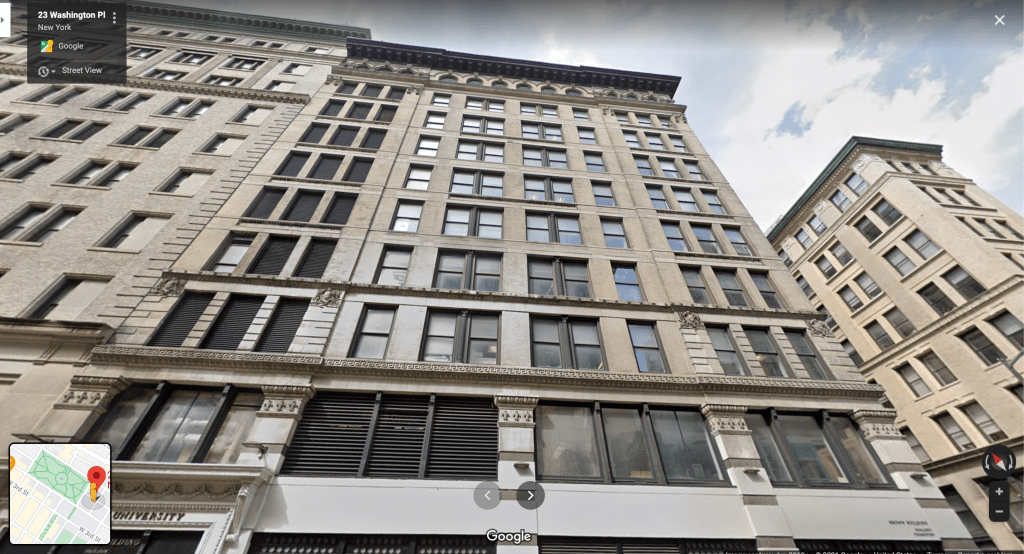
The Brown Building is located at 23 Washington Place near Washington Park, the building is now owned by NYU. The building is both a National Historic Landmark and New York City Landmark.
An oversized shirtwaist dress has been installed at 306 Bowery through the end of the week. Constructed by E. Jay Sims for a performance in 1984, the garment was hung to commemorate the fire and Women’s History Month. It is illuminated at night and billows in the wind.
Filmmaker Ruth Segel inscribes the name and age of every victim in front of his or her residence every year.
The only monument today is in Cemetery of the Evergreens, where six previously unidentified victims are interred. Identified by historian Michael Hirsch, the monument is of a kneeling woman. (Victims are interred in 16 different cemeteries. Twenty-two victims were interred in a special section of Mount Richmond Cemetery by the Hebrew Free Burial Association.) The Remember the Triangle Fire Coalition is currently raising funds for a memorial at the site of the fire. The proposed memorial wraps around the base and exterior of the Brown Building and features the names of the victims. The building currently has three plaques at its base, commemorating the fire.
A commemoration for the victims of the fire will be held virtually this year. You can register for the event at rememberthetrianglefire.org.
 agirlingotham.com