

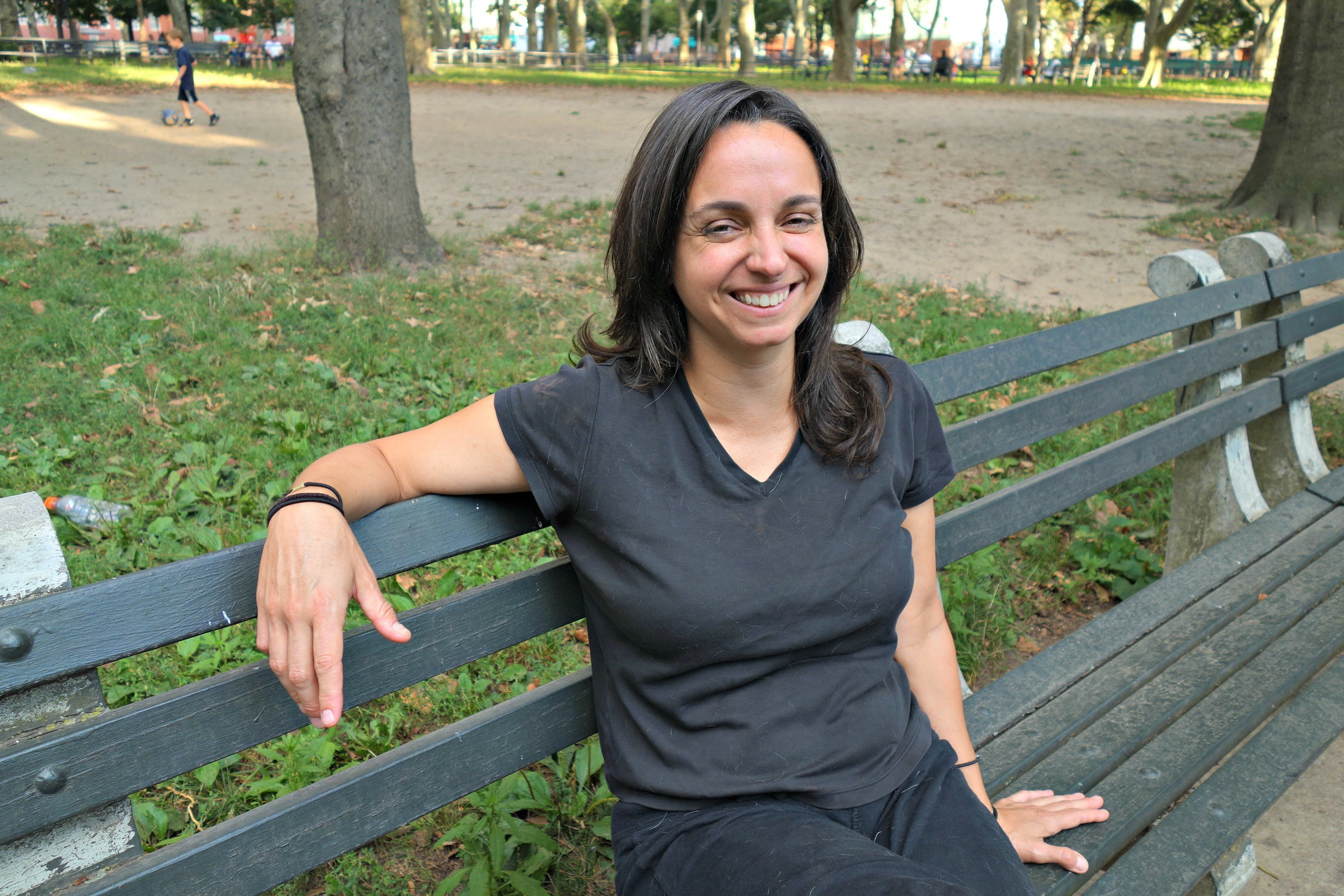
I have known Tim Haft and Heather Wagner for several years; I am thrilled they agreed to sit down with me to talk about the COVID-19 pandemic and the events of 2020 and 2021. I met them through Punk Rope, a fitness class Tim has been teaching since 2004. (I remember reading about it in Alternative Press when I was in college!) Tim also teaches Beastanetics, a high-intensity interval training boot camp I’ve been doing since 2013, is a DJ, a master declutterer, and runs weekly trivia at the Coney Island Brewery, where I work part time. Heather, who has also taught fitness classes for the group, and once allowed me to pet sit for her, is an accomplished and acclaimed drummer, instructor, and energy medicine practitioner. During the pandemic she worked in her neighborhood as a barista.
Tim and Heather spoke to me in early September about their experiences. This as-told-to interview has been condensed for length and clarity.
Tim: I think there’s the difference between what it really was like [before] and the distortion created by the height of the pandemic.
I, unlike a lot of people…try to minimize the distinction between pre-pandemic, pandemic—and eventually, we’ll get to post-pandemic. It’s a little dangerous to view the pandemic as once in a lifetime or once in a millennia event. I just don’t want to go there.
Pre-pandemic I was in a pretty steady routine. It was a routine like anybody else’s routine. It was comfortable. It centered on people I really like and care about.
Heather: [I was] playing a lot of music indoors and spending time with people, who I love. You know, working, in-person. I taught drumming to adults and kids and I practiced energy medicine, a hands-adjacent practice. That was not something that was possible over the pandemic. I did a couple of sessions in the park—masked—when the weather allowed.
I don’t know. General life: seeing friends, traveling.
I thought people would take it very seriously. People took it seriously overseas. I was surprised that things happened so quickly. I thought people were going to take it very, very seriously. I thought people would adhere to what the suggestions were—which also changed!
Tim: I don’t know if they didn’t take it seriously, or if they thought it would blow over very quickly. I knew in early March. Anytime in the United States you cancel or you alter a major sports competition, then you know, it’s like, “Oh shit.”
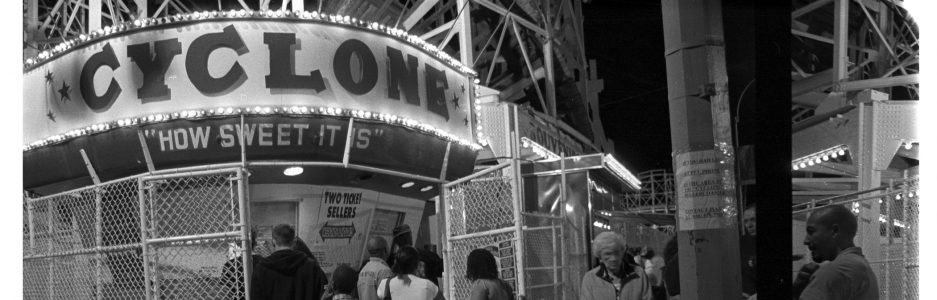
Heather and I went to the last concert that was held in New York City, to see Wire. It was a bucket list band for me, it was at the Music Hall of Williamsburg. We really debated, “Should we go?” because we knew the lockdown was happening the next day.
I do remember that we stayed away—it was somewhat crowded, but it wasn’t packed. It was a little sparse. People bought tickets but they chose not to go.
Heather: People were distancing themselves.
Tim: I don’t think it was six feet.
Heather: I remember asking [my friends] should I go, and at the last minute thinking it was the last concert I’d ever see.
Tim: I remember we asked Shawnette, an emergency room physician——so she was not a fan. She’s been super conservative this whole time. That was a big no-no.
I think it would have been that second week in March we realized, “Uh oh.” Even that prior weekend I went to college wrestling and it wasn’t clear it would happen. …And then the lockdown happened on the 13th or 14th.
And then I got sick on the 28th. Definitely from the subway, almost without a doubt from the subway.
At that time I’m not even sure what was happening with contact tracing. I was sparingly taking the subway, with a mask—always, and there were a couple of occasions where instead of taking the subway I walked over the Williamsburg Bridge and then I realized that’s not very practical. I was taking the L.
Me: Is it OK to say you were taking it to Heather?
Tim: I was probably taking it to Beast!
I remember thinking, “Oh, this is not safe.” I don’t know why I was sure it was the subway but I was as sure as I could be. It was that point, where it was exploding in the city and hospitals were filling up.
The first feeling was body aches. Like, intense, intense body aches. And then some fever, but fortunately not a lot of difficulty breathing, so that was good. Loss of sense of smell and taste, which did not come back for over a year, and has not come back 100 percent. In the midst of when the aches were really intense I was like, “This is how it ends.”
Then I remember calling my doctor, and he said, “Unless you think you really need medical intervention, don’t. Don’t go to the hospital.”
It lingered, and my lungs were severely compromised. For the longest time I could manage about ten to fifteen seconds of exercise before I was severely out of breath. Which, for someone who exercises as a living…
Then I was able to stretch it out and it’s about four minutes. So if you had to put it in quantitative terms, my capacity was diminished by a thousand percent.
Heather: I had it a few days after Tim did. I, to be honest, I could have chalked it up to seasonal allergies until I lost my sense of smell. It was in the beginning, so I didn’t panic. I did some breathing exercises…I consulted with a naturopath. It was really weird, it took about two weeks.
I thought, “Who will be left standing after all this.” A lot of people were gone, that I knew peripherally.
Tim: We knew people relatively early on who got it and died. It was more family of friends, and in Heather’s case friends of friends. We knew very early on people close to us.
Heather: There’s a part of me that tries to understand people who refuse to wear a mask or get the vaccine. …Yes there’s a choice about what you do with your body, on the other hand, we’re actually in a global pandemic, affecting other people. Yes, Big Pharma is a powerful entity, and yes, they’re out to make money. I find it so difficult to believe that there would be so many people involved in a coverup.
My skepticism with these conspiracy theories require so much organization, so much coordination and not one person is going to be the whistleblower? No one?
Tim: If you’ve ever worked for the government or ever worked for a large corporation you know how inefficient, incompetent—just there’s no way they can pull these things off. It’s impossible! When people concoct these outlandish theories, if you’ve had that experience, you know: “Come on, it’s not possible!”
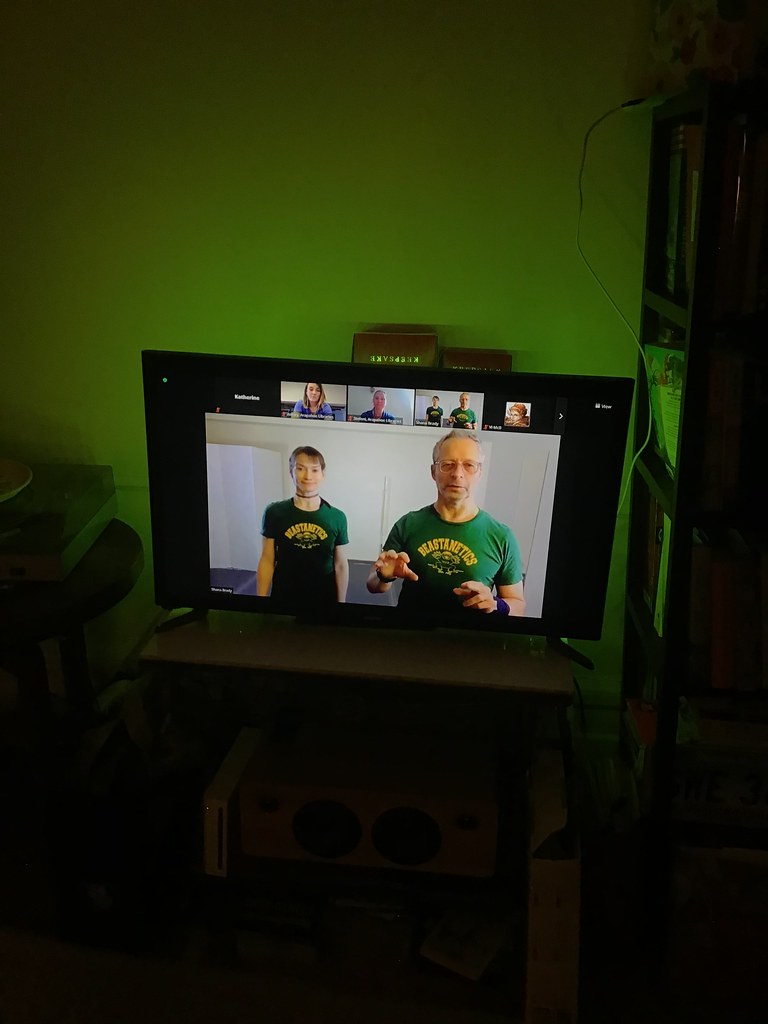
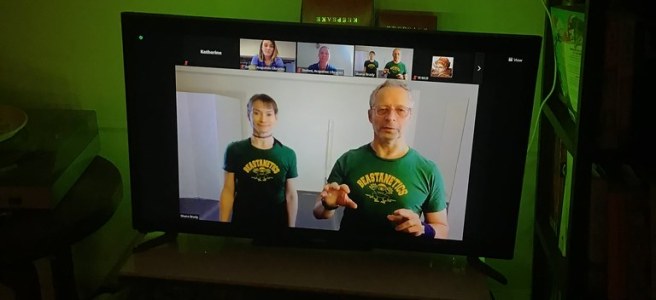
Me: You hosted Beast on Zoom, you joined the Zoom revolution! How did it go?
Tim: It was just nice to see people. For me what was especially fulfilling was being able to—it wasn’t so much about helping people get healthy or fit—it was providing them with something to do for an hour a couple of times a week. And to connect with other people they already knew or didn’t know, that felt really good. That was really special. To reach people not just around the country or around the globe, that was really cool! The regular classes were mostly local but a little bit international and I did a couple of classes with Creative Mornings and those reached people in practically every continent. It was the first time I felt like, “The internet is really cool.” Before that, I wasn’t that impressed. It wore off, but for a while…
It never felt like a grind to me. For the most part it kind of worked, I think.
Me: It was nice to log in and see Heather, “That’s Heather, that’s my friend!”
Tim: You could see their children! That was something that never happened before.
On the other side of it, there was one Punk Rope class with Zoombombing. I was teaching a class with this lovely woman and her six-year-old daughter and a handful of other people.
I don’t know, I didn’t take the security precautions that seriously, or maybe I didn’t know what to do. And all of a sudden there was this very graphic image of [a] pedophile. And it was horrific. I was so shocked—it was probably no more than a second or two before I kicked that person out, but I was just mortified. I reached out to everyone to apologize. As it turned out, thank god, the girl had already gone off to bed, and the mom [said] she didn’t see anything. It’s humanity at its absolute lowest. It’s really, really, really horrible. And then we tried to take more precautions after that.
Heather: I think after that Zoom [took on] more security.
Me: Were you able to support yourselves through any of the loans or pandemic assistance? It feels like no one got anything except Eataly.
Tim: I kept talking to people about it, and my accountant, and I was not eligible. It didn’t make sense, but I can pretty much confirm that I was not. It had to do with the structure of my business and the fact that I wasn’t generating very much revenue. That’s where it got twisted, because if you were a larger corporation you benefitted more, because you had payroll, et cetera, which I did not. One thing I realized was, “Wow, I don’t have much income and now I have even less.”
Eventually, I realized I was eligible for SNAP. I was reluctant to apply for it because I thought…is this who it’s for? Am I taking something away from someone else? Eventually, I was approved, that was the assistance I received. It’s an important program.
Heather: I was working at the coffee shop, and my landlord gave me a month for free.
Me: How was it, as an essential worker?
Heather: There were a couple of people who didn’t think they needed to wear masks. There were a couple of Polish men who were Trump supporters and seemed to espouse the rhetoric around QAnon. For the most part, the interactions were positive, and it kept me sane. I wasn’t around anyone, I couldn’t see my mom, my sister, my nephews, my friends. Being in the coffee shop, people picking up caffeine in the morning…It really helped me.
I discovered I’m an introvert. I spent a long time inside. I did the sourdough thing. I bought an electronic drum kit and spent a lot of time going through the rudiments on my drum pad. I now have Zoom students, too. It was a really good time to be quiet, to go inside, and just feel…
I kept hearing, “Shakespeare wrote King Lear in the pandemic,” but he also wrote a bunch of plays before then. I tried to resist the pressure that you have to be productive to come out with some new skills or something special. I’m just going to come out alive. I rocked it!
Tim: I felt that to some extent we were in it together, but I watched every documentary I could on Netflix—on every app we had—on the Black Experience in America. The pandemic almost took a backseat to everything else. I wanted to immerse myself in [something] different.
Are we in it together? Some people had it way worse. They had to go to work. It really hit me more than it ever has before, just the disparity, the inequity.
Heather and I went to a bunch of protests. We went to DC. It was profound. It was in late August, with Martin Luther King III and Al Sharpton. It was really large, really impressive. It was absolutely huge. It was peaceful, it was powerful. You kind of got the sense that this was the tipping point, that things were gonna change. I’m really glad we went.
It was a largely Black crowd. We left, and a postal worker came up to us and looked at us and said, “Thank you for being here.” It was really nice, everyone was super. Like, the opposite of a Proud Boys whatever.
Me: How was voting for you?
Heather: I voted the very first day, the very first hour.
I think if they made election day a national holiday when no one was going to be working anyway, there’d [probably be a better turnout].
Tim: We volunteered for Emily Gallagher, who was running in Greenpoint. We oversaw, or helped oversee, the counting of mail-in ballots, and she won! In a massive upset.
Me: Did you celebrate when the election was finally called?
Tim: There were fireworks, people were dancing. People were happy here. I was in Manhattan and I heard horns honking and people banging pans, and very quickly we went out to McCarren Park.
Me: Are you vaccinated?
Tim: Speaking of disparities in the healthcare system, I am connected with Mt. Sinai Hospital. I get pretty much all my care there. They sent an email…that allowed you to book a slot. But a lot of people didn’t have that opportunity. I got it the next day [in March]—the first day. [I’m getting the booster] tomorrow in Chinatown.
Heather: I’m a teacher, so I got a letter from the school in March. I’ll probably get the booster when it’s available.
I think this is not going to be the last time. I hope we don’t get to the Pi variant, to further ruin your Pi Day. I don’t think it’s going to go away. It’s part of our lifetime for the rest of our lives. The flu we get each year is a variant of the [1918 flu pandemic].
Tim: I think we humans live in a constant state of denial. It’s a double-edged sword. I think people are very optimistic about the future but they also ignore the lessons of the past which is not good.
For example, [Hurricane] Sandy happened in 2012. And now it’s nine years later, almost a decade, and we just don’t have our act together. Now we have another storm that obliterates a lot of neighborhoods, and not that we could have stopped the storm, we could have been better prepared. Heather and I were at the U.S. Open, and we got stuck, and we had to walk home from Court Square. The MTA just shut everything down instead of having some kind of contingency…to get people home.
It’s the same with the pandemic. We learned a little bit, but then we’re just—we don’t have the political will to do what we need to be doing to keep people safe. I think they’re burned out. We weren’t around in London during the Blitz. Do you think those people were like, “Fuck it, I’m not going to the bomb shelter, I’m over this!”
Heather: I know people who are anti-mask and there’s nothing you can say that will change their minds. There are a lot of people in my life who vocally… I just try [to talk to them.] It’s the only way we’re going to get through this.
Tim: It’s ironic to espouse the rights of an individual versus the collective. If you take care of your neighbors, you’re a communist. In a way, that’s what enabled you to survive. If it’s all about you and your individual freedoms, the virus will spread and the pandemic will continue, and it will come back to you and we’re seeing that with these right-wing talk show hosts who are getting sick and dying. They’re killing themselves. I just hope people realize that in a way taking care of their neighbors is taking care of themselves. I don’t think that’s going to happen, but we’ll see.
 agirlingotham.com