

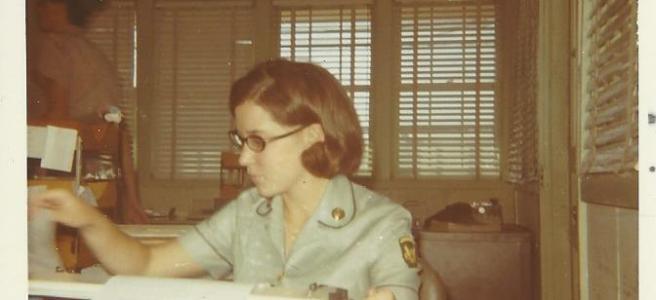
My mom is a proud Army veteran. My limited understanding of her enlistment is that Mom wanted to see the world, so she joined the military.
She was sent from her home in North Dakota to Fort Gordon in Georgia, where her peers played “Hey Jude” repeatedly; it’s where, how, and why she met my dad. They worked together in the administrative offices of a hospital. One of her responsibilities there was assisting in the transport of the deceased.
One transport was Mary, whose death was the result of “inadequate health care.” I’m withholding Mary’s last name for the privacy of her family. It’s not shameful to die as the result of an abortion but I think it hurts to stumble on a stranger writing and remembering someone you love.
Mom escorted Mary’s body to her home, St. Petersburg, in 1969. They arrived together, in December 1968 for service and Mary died the following spring.
Mom worked 8 a.m. to 5 p.m., Monday through Friday, while Mary was a medic. They shared the bunk with four other girls, and despite never sharing the same shift, Mom wrote, “I knew her well enough to get sick drinking way too many rum and cokes with her, and the rest of the room.” I was a teenager once. I know how drinking with peers brings people together.
Mary died in the hospital. “I did not know she was having an abortion beforehand, although I knew she was pregnant and looking,” Mom wrote. An ambulance was called during the day. “I was working, so I was not there for that. I was there in the middle of the night when she returned, and when I went to work in the morning, she was huddled under her covers. Another roommate was there with her.” In a followup she wrote, “We came to know if a girl was huddled under blankets in the middle of the day, abortion was a very real possibility.”
I wondered what her death certificate said. Mom didn’t know. “But there were certainly many others who were hospitalized for excess bleeding, who were treated and sent back to duty. You do not have to die on duty, or on base, for military honors.” I was surprised; I thought you had to die nobly, but Mom explained, “You are owned by the military 24 hours a day, so if you die, you are still theirs, no matter where you die.” Flu or illness, for example, but Mom escorted a woman who died of an overdose after returning from Vietnam. “Hers was listed as injuries in a combat zone. She was hospitalized at Fort Gordon, but [she] was never actually stationed there…escorts were just chosen, as opposed to people who knew her.”
A concern now is the criminalization of having an abortion or miscarriage. We’ve stopped tracking our periods on apps. We’re supposed to buy tampons with cash and keep track of our cycles in pen, in private calendars. “In the years I was there and abortion was illegal, I never saw or heard of anyone who was charged for having one, so I think the doctors just tried to help,” Mom wrote. “It was common knowledge later on that there were certain groups you should turn to for help for a safe termination–sort of like Planned Parenthood, I guess, or The Janes. If you chose to keep the baby, you were of course, discharged as soon as the paperwork could go through, and I knew people who also chose that route, in order to get out.”
In a separate conversation, Mom told me that her mother paid the maternity fees of another roommate. Her roommate’s hospital and prenatal bills were not covered by insurance. A year after the baby was born, she married a man who adopted the girl. The past is the same as the present. “It was awful enough then, and way more awful now,” she wrote.
In another email, she asked her three daughters to read a Monica Hesse column. “Most women my age have stood over a bed with a writhing in pain woman, who is bleeding uncontrollably. Any woman who denies this is either lying, has lived a very sheltered life, or was not deemed trustworthy enough to keep the secret. To this descriptive article, let me also add, military-grade blankets are NOT absorbent.” I know. We spent every Fourth of July crowded on Mom’s Army blanket. It irritated my bare legs.
I think a lot about Mary. She had three sisters and one brother. They might have had children, who miss an aunt. Mary might have wanted children, later. The world has been denied Mary’s presence and skills. Her dreams and desires remain unfulfilled.
Mom toured Women In Military Service of America Memorial (WIMSA) in May. Veterans were invited to hang yellow ribbons for those who had perished in service since 9/11. They invited mom to tie a second ribbon for anyone she wanted, so she tied a ribbon for Mary, too.
Pictured: My mom at work, the late 1960s, photographed by my dad.
 agirlingotham.com